
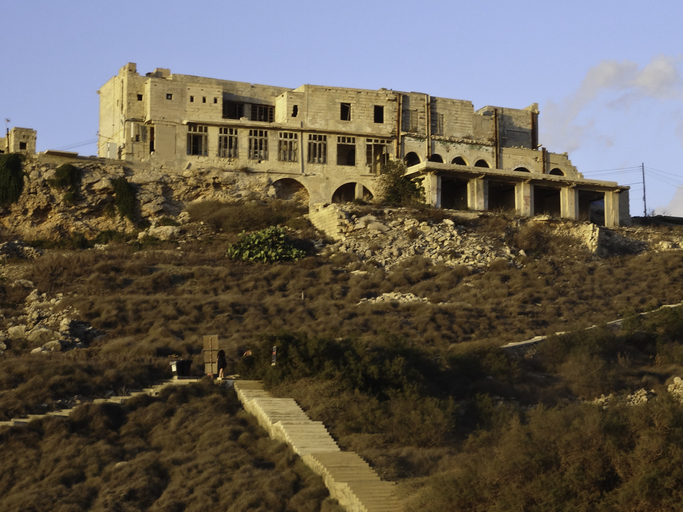
Appeals Court confirms that the Lands Authority is entitled to recover a tract of land originally granted for the extension of the Riviera Martinique Hotel.
For decades, the Riviera Martinique Hotel in Għajn Tuffieħa has stood closed and deteriorating. Now, a condition buried in the contract under which neighbouring government land was granted more than 60 years ago, has enabled the state to take that land back. This was held in a judgement delivered by the Court of Appeal on 5 August 2026 in Land Commissioner vs NMF Limited.
Appeals Court confirmed that the Lands Authority is entitled to recover a tract of land originally granted for the extension of the hotel, after finding that a condition requiring the hotel to remain in operation continued to bind successive owners even after the annual ground rent was redeemed.
NMF Limited had redeemed the perpetual ground rent in 2008. But redeeming the ground rent did not free the land from the conditions attached to the original concession.
At the heart of the dispute was a 1960 emphyteutical concession which contained a simple condition that if the Riviera Hotel remained closed to the public for one continuous year, or a total of 30 months over four years, government would have the option to take the land back.
The 1960 concession was made to Cristino Camilleri, who then owned the Riviera Hotel, specifically so that the hotel could be extended onto part of the government land. Camilleri was required to spend at least £1,500 on the extension, while the agreement also gave government the option of terminating the concession if the works were not completed within five years.
Importantly, the hotel and the land granted by government were not one and the same. The Riviera Hotel stood on separate land which had been acquired from government in 1929 and was privately owned. The 1960 concession concerned adjoining land, part of which was eventually developed into a restaurant and beach bar.
Over the following decades, the land changed hands several times. Camilleri transferred it to Riviera Investments Limited in 1965, which in turn transferred it to Golden Sands Limited in 1978. In 1999, NMF Limited acquired the Riviera Martinique Hotel together with its surrounding lands. By then, however, the condition at the centre of the dispute had already been breached.
The judgement records that the last hotel licence was issued in 1986, while correspondence dating back to 1985 informed the authorities that the hotel had closed. NMF maintained that the hotel had continued operating until 1988, but there was ultimately no dispute before the court that it had not operated as a hotel since at least that year. This meant that when NMF acquired the property in 1999, the Riviera Martinique had already been closed for more than a decade.
The Court of Appeal found that this did not allow NMF to acquire the government land free from the obligations imposed almost 40 years earlier. In reaching that conclusion, the court invoked the legal principle nemo dat quod non habet (nobody can transfer more rights than they themselves possess). Golden Sands Limited could therefore not pass the land on to NMF stripped of the conditions attached to it.
The breach, moreover, did not end when NMF became the new emphyteuta. The court noted that the hotel remained closed well after the 1999 acquisition and even after the Lands Department formally recognised NMF as the new emphyteuta in 2004.
NMF nevertheless argued that government’s own conduct mattered since the Lands Department had recognised it as emphyteuta without reservation and continued receiving the annual ground rent, despite knowing the hotel had been closed for years. The company also pointed to its efforts to redevelop the site that repeatedly ran into difficulties with the authorities.
Planning applications had been filed over the years. One proposal sought to demolish the existing hotel and construct a four-star hotel and beach bar, but was refused. Another outline permit was later issued for the demolition of the dangerous structures and replacement with a two-storey building incorporating a restaurant and multi-purpose hall.
On 31 July 2008, the Commissioner of Lands took the matter to court, asking for the 1960 concession to be terminated and for government to recover possession of the land. It was only after those proceedings were filed that NMF took the step which would become central to its defence. On 9 December 2008, the company redeemed the perpetual ground rent. NMF argued that the redemption left it as the absolute owner of the land and brought the obligations arising from the emphyteutical concession to an end.
The Court of Appeal disagreed.
The court explained that redeeming the ground rent could not retrospectively make permissible what had already been done in breach of the conditions. More fundamentally, the court held that an emphyteuta could not rely on a redemption carried out after proceedings had already been instituted to escape the consequences of an earlier serious breach.
The Appeals Court refused to treat the 1960 condition simply as a technical relationship between two neighbouring properties. Government had not simply transferred a parcel of public land for unrestricted use. It had granted it so that the existing Riviera Hotel could be extended onto it, with the continued operation of the hotel forming part of that arrangement.
The court stressed that the concession of public land had been granted for a specific tourism purpose and that the condition bound the owner both in relation to the land granted on emphyteusis and the adjoining site on which the hotel already stood.
Crucially, the court said this obligation remained binding whether NMF held the site under perpetual emphyteusis or had subsequently become its owner through the redemption of the ground rent.
The court also noted that the hotel had remained closed since at least 1988 and was in a dilapidated state.
The court regarded the 1960 condition as a determining factor behind government’s decision to grant the land in the first place. Its breach therefore went to the heart of the original agreement. Applying the principle of pacta sunt servanda, that agreements must be kept, the court concluded that the continued closure of the hotel amounted to a breach of an essential contractual condition and justified the termination of the concession.
The judgement makes a clear distinction between the land which formed part of the 1960 emphyteutical concession and the separate land on which the original hotel had been built, which is privately owned by NMF. The Lands Authority is entitled to recover only the former, while any rights NMF may have to compensation under the terms of the original 1960 contract remain unaffected. NMF would be entitled to the value of improvements made to the land, subject to a ceiling based on the increase in value those improvements had produced.
The Appeals Court rejected all NMF’s grounds of appeal and confirmed the first court’s judgement in its entirety. The deed formally dissolving the emphyteutical concession and devolving the land is now set to be published at the Valletta courthouse on 26 October 2026 at 10am.
This article may also be accessed on MaltaToday.