
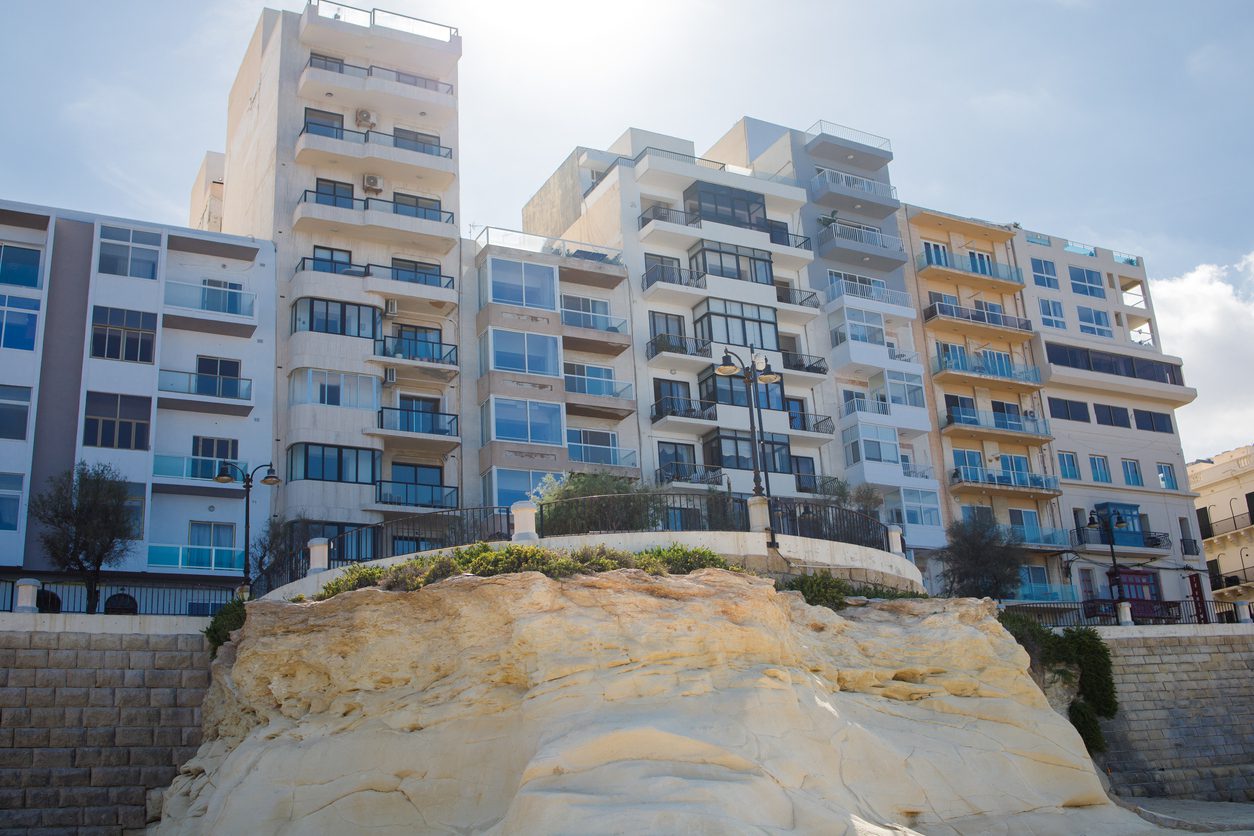
A recent Court of Appeal judgement clarifies the limits of an airspace owner’s right to build where underlying apartment owners enjoy rights over the roof.
Disputes concerning the airspace of apartment blocks have become a common occurrence. In cases where the airspace is owned by a single owner who has reserved the right to develop it, aside from the public law hurdles associated with obtaining a valid development permit, there often exist additional private law considerations affecting the owners of the underlying apartments. This tension was illustrated in the case of John Bartolo et v. Joseph Attard et, decided by the Court of Appeal on 17 June 2025.
The dispute arose from a block of apartments in Żebbuġ, Gozo. The owners of four underlying apartments had acquired their properties under deeds expressly granting them rights over the uppermost roof of the block. These rights covered all normal use of the roof, including drying clothes, sunbathing, and the installation of water tanks and television aerials.
While the deeds reserved in favour of the developer and successors in title, the right to develop the airspace if the necessary permits were issued, they also stipulated that, should development take place, the apartment owners’ rights would attach to the “resulting” uppermost roof. Any relocation expenses were to be borne by the developer.
In 2020, the owners of the airspace obtained the necessary planning permits to construct a penthouse. As by law penthouses have to be recessed, the superficial area of the roof available to the apartment owners would be significantly reduced.
The owners of the underlying units felt aggrieved, arguing that the proposed development would diminish the usable roof space, make access more inconvenient and increase congestion among owners. They maintained that this amounted to an unlawful prejudice of their rights.
The owners of the underlying units filed a case before the Court of Magistrates (Superior Jurisdiction in Gozo) against the developers, wherein they asked the court to declare that the development would prejudice their rights, and consequently to disallow the developers from constructing the penthouse.
The first court distilled the dispute to a single, central question: Whether the owner of the airspace who has a right to develop, may exercise that right in a manner that reduces the superficial area of the uppermost roof, when the underlying owners enjoy servitudes over that roof. The defendants argued that the reference to the “resulting” roof in the deeds of acquisition of the plaintiffs contemplated the possibility of a smaller roof area following development.
The court however rejected this interpretation. It held that the servitudes granted were use of the roof, and that under Maltese civil law the owner of the servient tenement may not do anything which diminishes the exercise of the servitude or make it more inconvenient. A reduction in roof area brought about by a recessed penthouse would, by its very nature, undermine the substance of the right enjoyed by the owners of the underlying units.
The court stressed that while it was true that the owners of the airspace have a right to develop, this right is not absolute. Any development had to respect the equivalence of the servitude, meaning that the owners of the underlying apartments should continue to enjoy substantially the same roof area, accessibility, and utility as before. In the absence of their consent, a development that materially reduced the usable roof space was not permissible.
Aggrieved by the decision of the first hall, the owners of the airspace appealed, arguing that the first court’s interpretation of the term ‘resulting airspace’ was incorrect. However the Court of Appeal disagreed and confirmed the judgement of the first court. The Court of Appeal emphasised that notwithstanding the right of the owners of the airspace to develop, this right must be exercised in a manner that does not prejudice pre-existing servitudes. The Court cited Article 474(1) of the Civil Code which explicitly states that the owner of the servient tenement, that is the tenement upon which the servitude is created, in this case the roof, cannot do anything which tends to diminish the exercise of the servitude, or make such exercise more inconvenient or alter the conditions of the tenement upon which such rights are created. The Court of Appeal therefore confirmed the first instance judgement.
This article may also be accessed on MaltaToday.